
Mentor Previous Residents by Era
One Mentor address can leave several kinds of dated evidence. Begin with the current parcel identifier and legal description, then choose the source that fits the period in question. The Recorder establishes a document trail, directories offer edition-specific address listings, and maps or census schedules add context. None of those records proves a continuous connection by itself. The most reliable result states what the source shows, when it was made, and what remains unconfirmed.
| Source | Years It Covers | Where Held | What It Shows |
|---|---|---|---|
| Recorder deed and mortgage books | Beginning 1840 | Lake County Recorder record room | Recorded parties, instrument date, and legal description |
| Recorder Official Public Record / electronic index | 1983 / 1986; images stated from 1987 | Recorder, AVA, request, or account route | Modern record-system context and a document-search lead |
| Haines & Co. criss-cross directories | 1976, 1977, 1981-1987, 1989, 1991-ongoing | Morley Library | Dated address-oriented listings |
| Mentor-inclusive directory titles | 1940, 1942, 1954; 1961; 1962, 1964, 1965; 1966-1990; 2000-ongoing | Morley Library | Listings under source-specific locality names |
| Lake County census and public federal census | 1840-1880, 1900-1930; 1950 newest public census | Morley Library and National Archives | Dated household and geographic context |
| County historic atlases | 1840, 1857, 1874, 1898, 1915 | Lake GIS / Morley links | Road, lot, landholder, and place context at the map date |
Use recorded documents for a property transfer question. Use a directory or census for a dated household question. Use an atlas to test the period road or lot, not to declare a modern parcel match. This separation helps previous-resident research stay accurate when one address has changed form over time.
Start Mentor Previous Residents with a Parcel
The Lake County Auditor is the first stop for a known Mentor street address. Its Basic Search offers Parcel ID, Owner, Address, and Postal Code paths. Entering the exact address creates the parcel lead, but the key fields to retain are the parcel identifier, property location, legal description, and access date. A tax mailing field is only the address used for tax correspondence. It does not establish who lived at the property.
Lake Navigator can then confirm mapped context, jurisdiction layers, and street alignment. Search by parcel identifier, owner or name, or address, then use the Layer List and Legend to identify map sources. Parcel lines are not survey-accurate, so they should not settle a boundary question. The parcel ID and legal description are the more durable bridge from a present address to a historic deed.
For a City-issued record, send a defined request to the department that created it, with the address, date span, and document type. A local permit may show that a City process or document exists, but it does not establish a completed project, present condition, or household connection.
Note: Preserve the Auditor's field label exactly, especially when the record calls an address a situs or tax-mailing address.
Lake County Time Bands for Mentor Previous Residents
Lake County's Recorder access dates explain why an online search is only one part of the property trail. Deed and mortgage books begin in 1840. The Official Public Record began January 3, 1983, the electronic index begins in 1986, and the County states that document images are available from 1987 through its stated search or request routes. An online miss before those bands is a reason to use the record room or a defined request, not a conclusion that no document exists.
- 1840: Deed and mortgage book research begins at the Recorder's record-room route.
- 1983: The Official Public Record creates a new county record-system context.
- 1986: The Recorder states that its electronic index begins.
- 1987: The County states image availability from this point through the listed search or request paths.
The Recorder's official AVA basic-index route is the electronic entry point shown here.
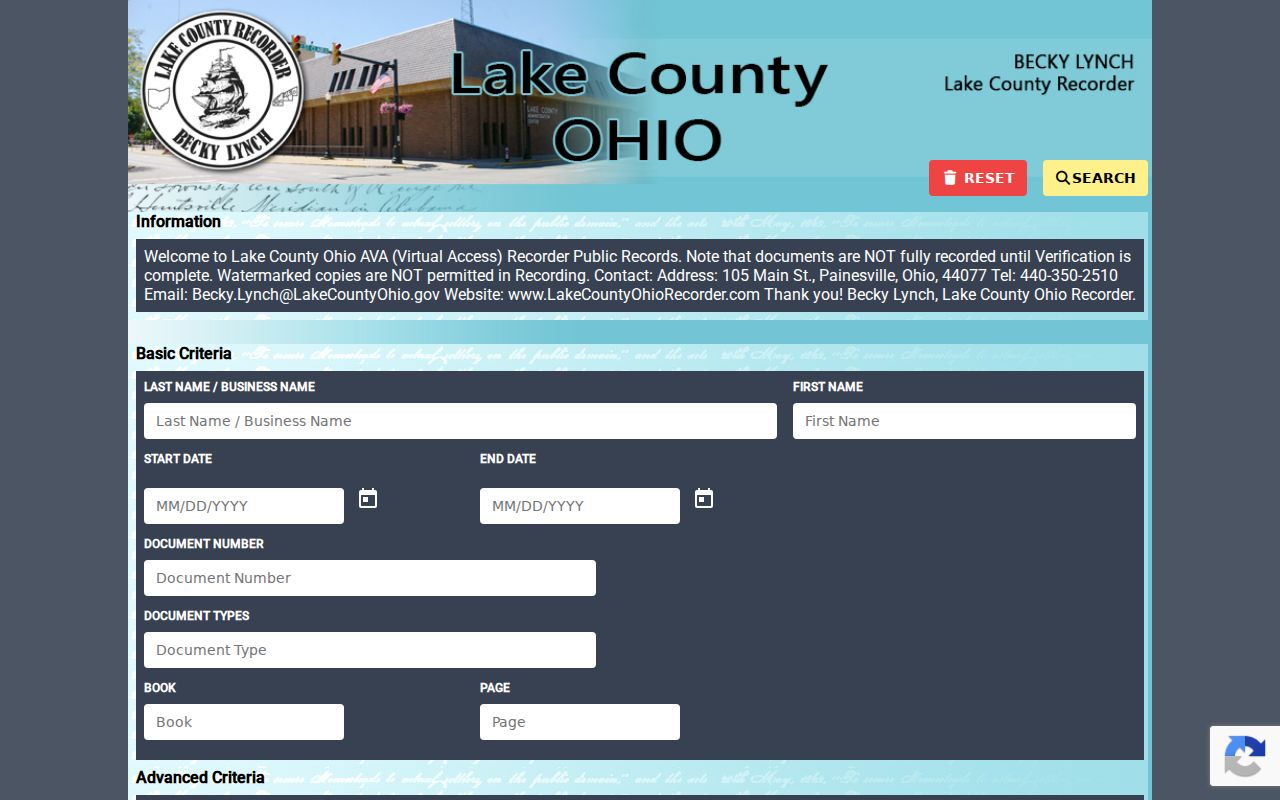
The research record did not capture a verified live AVA field list, so use the official page for current controls. The Recorder also identifies on-site public computer stations, physical books, staff assistance, email, fax, and public-record requests as other access channels.
Trace Mentor Past Residents Through Deeds
For a historic chain, start from a current or later recorded instrument and walk backward through the legal description. Read a transfer document before treating the Auditor owner field as history. A conveyance date and recording date can differ, so retain both when the instrument gives both. A mortgage, release, easement, or replat may appear in the sequence without transferring ownership and should be labelled for what it is.
- Find the parcel ID and legal description in the Auditor record for the Mentor address.
- Use that document lead at the Recorder to locate the later acquisition instrument or request a defined copy.
- Record the document type, recorded date, grantor, grantee, and legal description from the instrument itself.
- Search the prior party and the same legal-description terms in the earlier period, then compare lot, tract, subdivision, or plat wording.
- Repeat backward only where the documents support the link. For pre-index material, use the record room and deed books rather than guessing from an online gap.
- Grantor
- The party conveying an interest in the recorded instrument.
- Grantee
- The party receiving the recorded interest in that instrument.
- Chain of title
- A dated sequence of documented property interests. It is built from instruments, not from an untested name match.
- Legal description
- The tract, lot, subdivision, plat, or other land description used to connect documents when street wording changes.
Mentor Previous Residents Need Source-Specific Addresses
The important local quirk is not a confirmed renumbering story. Research found no official Mentor-specific street-renumbering or renamed-street crosswalk in the reviewed City, County GIS, Recorder, and library sources. A deed may use a lot or tract with no modern street number. A directory after 1923 may list a numbered address. A historic atlas may show a landholder or road but not either number.
When those descriptions differ, retain each source's own wording. Compare road or intersection, township or city context, range or lot terms, plat history, map year, and Recorder instruments. State a possible geographic correspondence only when the evidence supports it. If the link remains uncertain, the honest result is an unconfirmed connection.
Address caution. Do not build a conversion table from similar street names. A legal description and dated Recorder document are stronger evidence than a guessed number change.
Past Mentor Households in Directories and Census
Property transfers and household listings answer different questions. Morley's Mentor-inclusive titles are a practical route for dated address listings, while the Haines & Co. Lake-Geauga criss-cross runs provide an address-oriented layer for their listed editions. The collection details and locality titles remain concise on the Mentor city directory collections page; for this address trail, record only the edition that fits the period.
Morley holds Lake County census microfilm for 1840-1880 and 1900-1930. The 1890 federal population census was destroyed, with pensioner and widow schedules noted as a partial substitute. The National Archives public 1950 census is the newest federal census route. Census and directory entries should be compared as separately dated records, not joined simply because a surname appears in both.
- Choose a directory title whose printed locality includes the historic Mentor label for the target period.
- Copy its edition year, page, spelling, and address wording exactly.
- Check the nearest available census year, retaining the city or township, enumeration district, and page context.
- Use a historic atlas or Recorder instrument to test the place connection before describing one continuous address history.
The Lake County OHGenWeb 1906 Painesville directory transcription shows the kind of dated entry context that should be retained.
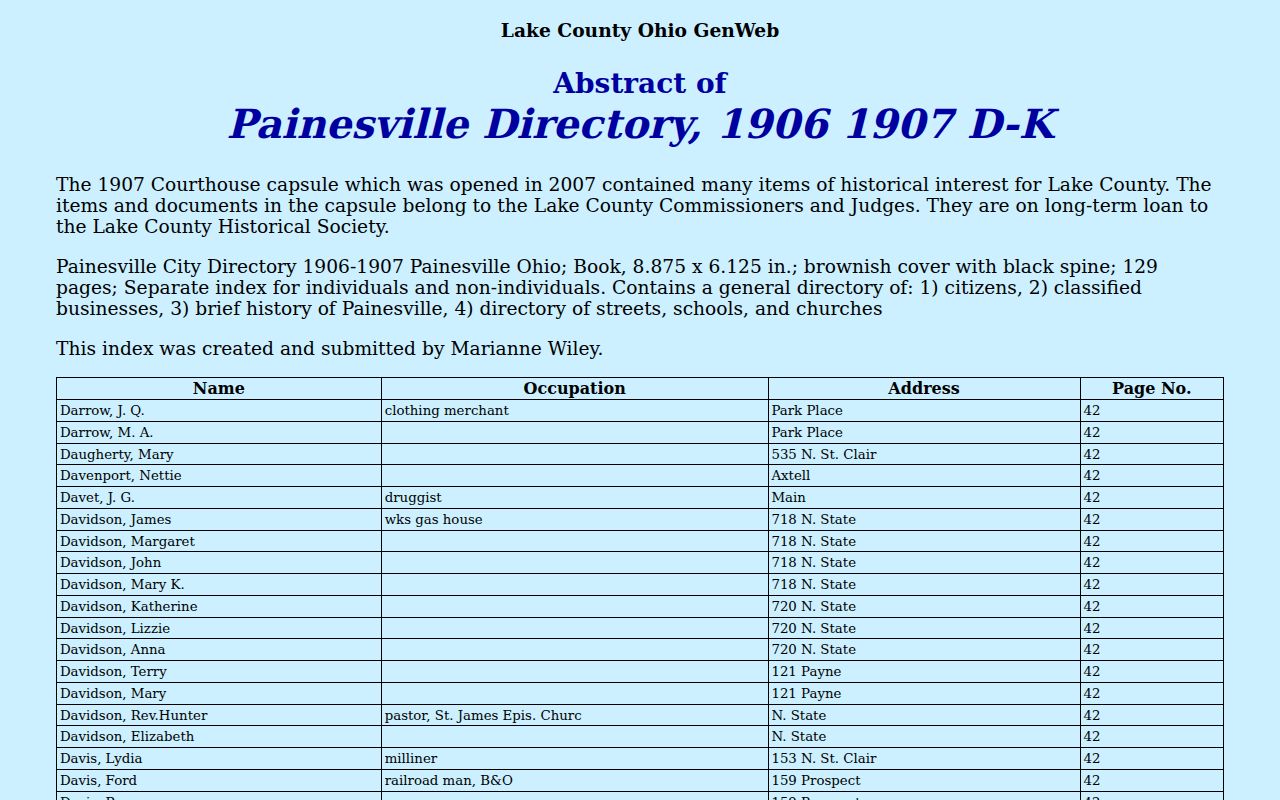
The observed transcription pattern has a name, a descriptive middle column, street address, and page context. It is a historical Painesville example, not evidence that every early volume contains Mentor listings.
Mentor Previous Residents in Dated Local Notices
Newspapers, obituaries, and local collections can add dated context after a property or directory search, but they are not a substitute for the deed chain. Morley's Mentor Monitor run covers February 23, 1939 through August 1972. The Library also lists Painesville Telegraph, News-Herald, Northern Ohio Journal, Painesville Republican, and Willoughby Gazette coverage with differing date ranges.
Morley warns that some newspaper portions are not on microfilm, including the Painesville Republican and parts of the Painesville Telegraph around 1890-1910. A negative search should therefore say only that an item was not located in the indexed coverage searched. Keep the publication, issue date, page, and the nature of the notice with any result.
The Lake County History Center can provide a separate catalog lead for a regional photograph, family paper, engineering drawing, or local document. Its catalog search uses OR by default, with AND, quotation marks, wildcards, and People or Creator fields available for a narrower inquiry.
Limits on Mentor Previous-Resident Research
Use past-resident research for house history, family history, estate questions, or personal curiosity. Do not use it to follow, confront, or harass any living person. Ohio address-protection programs and source-specific redactions may limit what is public, and a missing result does not identify the reason.
Separate an Auditor tax-mailing field, a Recorder party, a directory listing, a census household, and an obituary notice. They have different dates and meanings. A record may be incomplete, in another jurisdiction, outside online coverage, or unavailable through the public view. Direct questions to the office that keeps the record, and ask for a defined document or date range.
Lawful use. Keep the focus on the history of the property and its records. Never use historical material to target or intrude on a living person's private life.